

Skin & Regeneration
Hyojung Moon, MD, Gave an English NAD+ Talk on Pores and Post-Acne Skin at ASLS 2026
On November 8, 2026, Hyojung Moon, MD, director of Beyond Clinic, gave an English talk on pores and post-acne skin at COEX, Seoul. It took place in D Room during ASLS KOREA 2026 AUTUMN CONGRESS. The 15-minute lecture covered the role of NAD+ (nicotinamide adenine dinucleotide), combination observations, and a proposed next comparison. The speaker disclosed a Vitamedical-related conflict of interest on the slides. These small, uncontrolled observations cannot isolate NAD+’s contribution or predict an individual’s result.
ASLS 2026 talk series: ① Evidence and limits · ② Talk findings and limits of uncontrolled observations · ③ At the ASLS 2026 talk (this article).
About this article
This is a primary record of a conference presentation, including the speaker’s English remarks.[1] The site editorial team did not author the cited literature. This article does not assess authorization, classification, or indications in Korea.
Presentation record
| Item | Record |
|---|---|
| Speaker | Hyojung Moon, MD, director of Beyond Clinic.[5] |
| Event | ASLS KOREA 2026 AUTUMN CONGRESS, the autumn international congress and aesthetic medical device exhibition.[3] |
| Dates and venue | November 7–8, 2026, COEX, Samseong-dong, Seoul.[3,4] |
| Lecture date and room | November 8, 2026, D Room.[2] |
| Language | English |
| Title listed in the Korean-language schedule | Remodeling Pores and Post-Acne Skin with an NAD+ Bioactive Platform |
| Official English registered title | Remodeling Pores and Post-Acne Skin with an NAD+ Bioactive Platform |
| On-screen title | Metabolic Remodeling of Pore- and Acne-Affected Skin Using an NAD+ Bioactive Platform |
| Name variants | Hyo Jung Moon in the official program and Hyojung Moon, MD on screen identify the same speaker. |
| Schedule | 15:10–15:25, a 15-minute lecture |
| Slide count | 19 English-language slides |
| Session and chair | Pore Treatment & Beyond, Plus Hair Removal; chair Yong-ho Hwang, Well Skin Clinic, as listed in the event schedule. |
| Source records | ASLS 2026 official program; Profile of Hyojung Moon, MD.[5] |
Key points
- Hyojung Moon, MD, gave a 15-minute English lecture on NAD+, pores, and post-acne skin at the ASLS 2026 autumn congress.
- The 19 slides covered NAD+ biology, three selected cases from six people receiving two combined sessions, related literature, and a proposed next study.
- The speaker stated that the observations lacked a comparator, relied on photographs with limitations, and did not measure intracellular delivery.
- A split-face trial was proposed using the same RF on both sides, with the NAD+ formulation on one side and a matched vehicle on the other.
First, the basics: the talk’s question
The lecture opened with a question about supporting the metabolic processes needed for repair after a procedure stimulates skin. NAD+ is a coenzyme, a substance that helps enzymes carry out reactions involved in cellular energy metabolism and responses to damage.[1,8]
The observations presented involved an NAD+ formulation applied alongside radiofrequency (RF) microneedling, a procedure using small needles and RF energy. The term combination describes this joint application. There was no control using the same conditions without the formulation.[1]
The registered title uses post-acne skin broadly to mean skin that has experienced acne. Red or brown marks and depressed scars require different assessments. A title referring to post-acne skin does not establish treatment efficacy for depressed scars. See Why Acne Marks and Scars Should Not Be Treated as the Same Thing.
Remodeling refers to tissue reorganization, a process these observations did not verify through biopsy or intracellular NAD+ measurements.
The observation methods and the three cases are described in article ②.[7]
A photographic record of the day
All photographs were taken at COEX on November 8, 2026. They move from the lobby and program board to the lecture stage, speaker wall, and badge. Times below come from photo metadata and are in Korea Standard Time (KST).

09:20. Hyojung Moon, MD, stands in a coat beside the large illuminated #ASLS letters in the venue lobby.
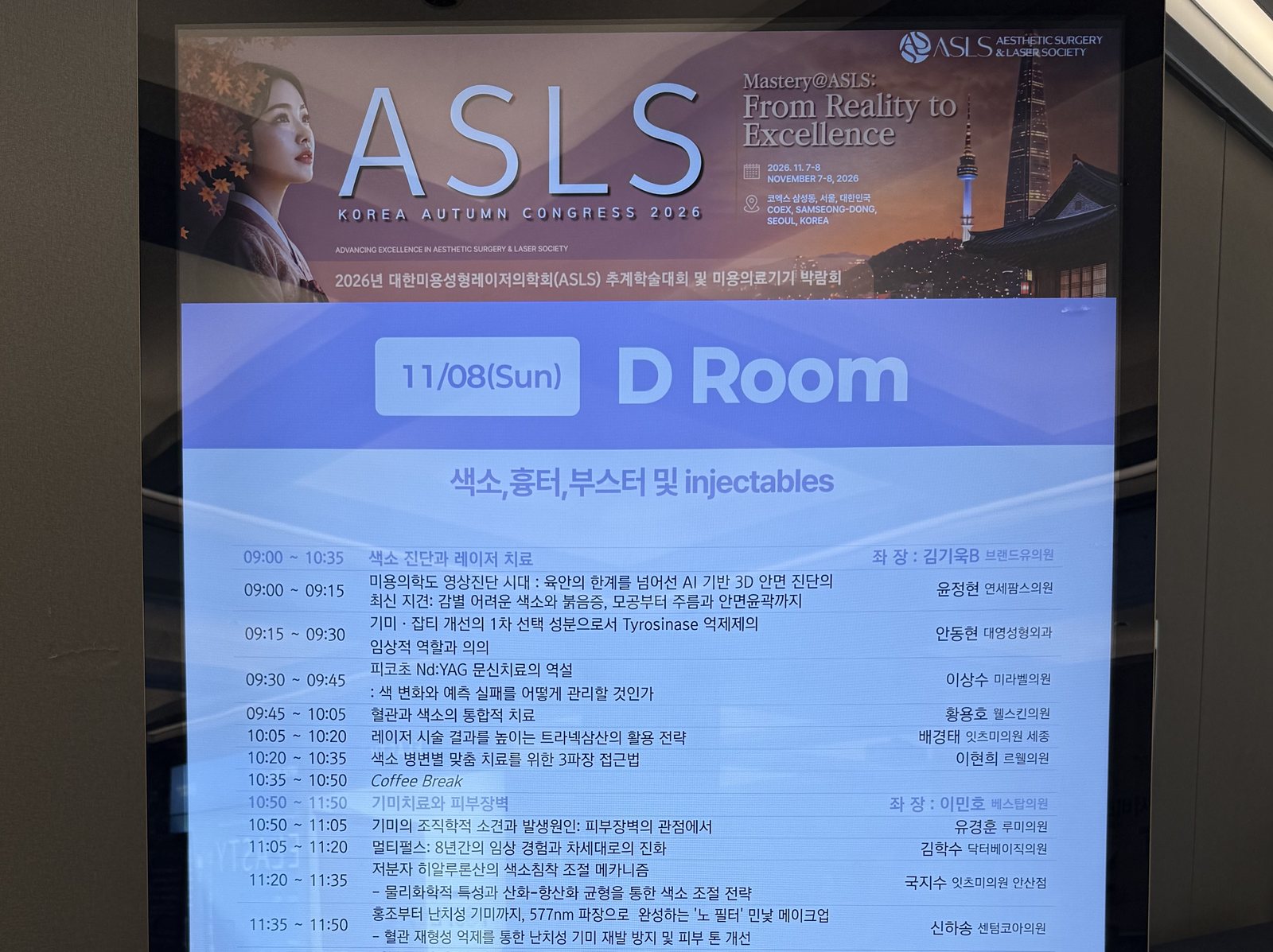
09:33. The digital board displays the Sunday, November 8 D Room schedule for pigmentation, scars, boosters, and injectables.
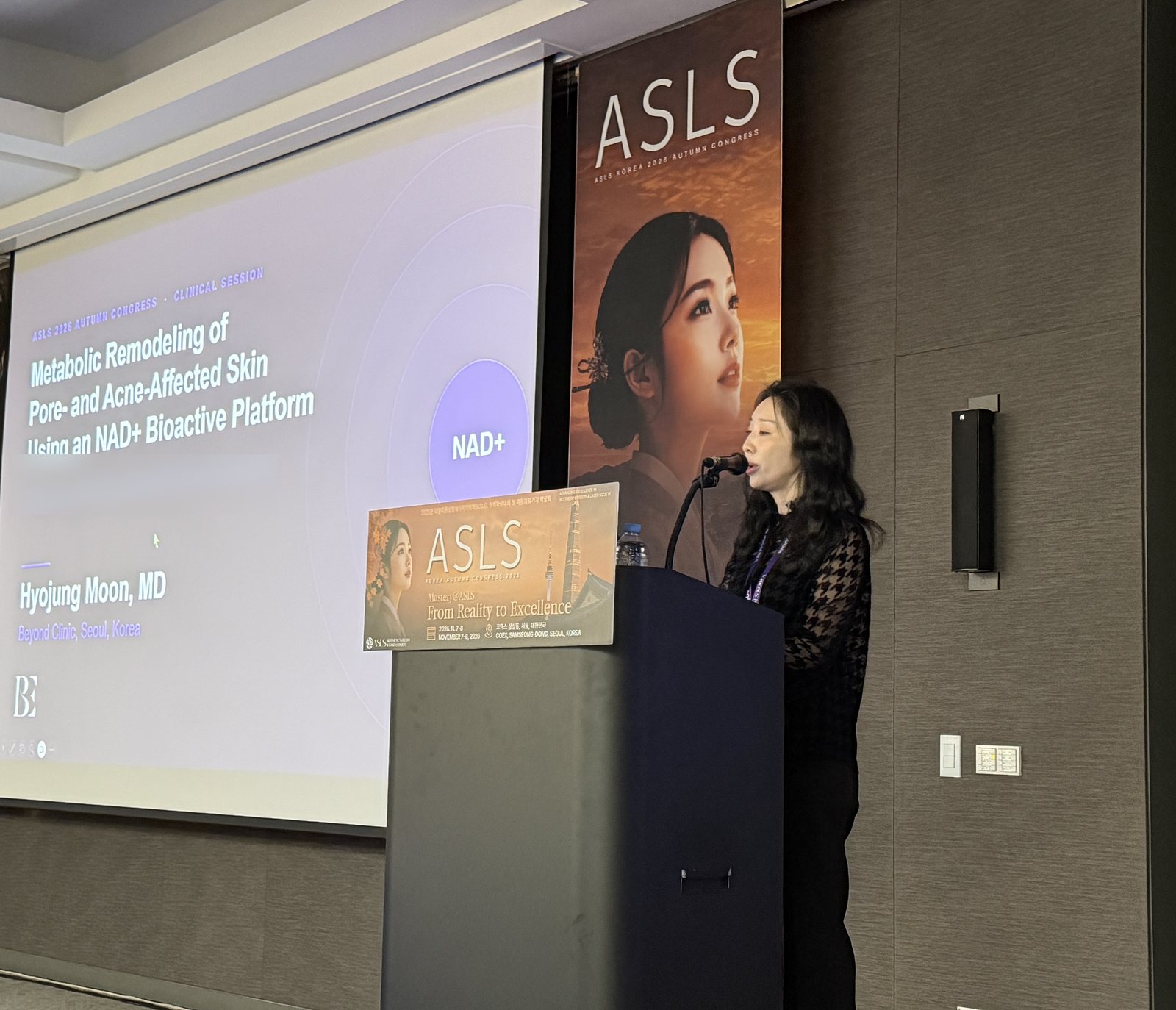
15:10. The D Room screen shows the English title slide and the name Hyojung Moon, MD, with the speaker at the podium.
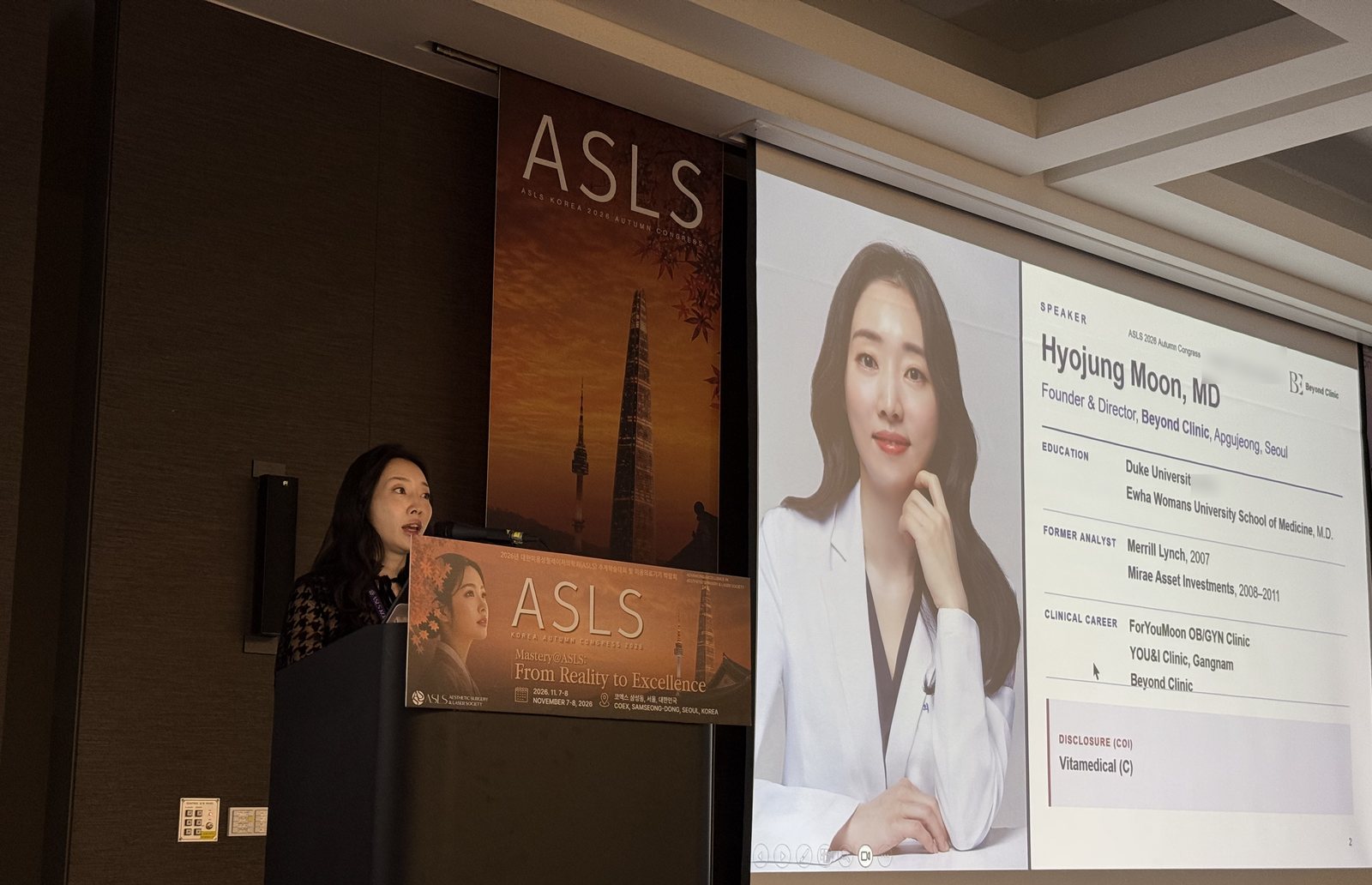
15:11. The speaker introduction slide lists education, career, and the conflict-of-interest disclosure Vitamedical (C).
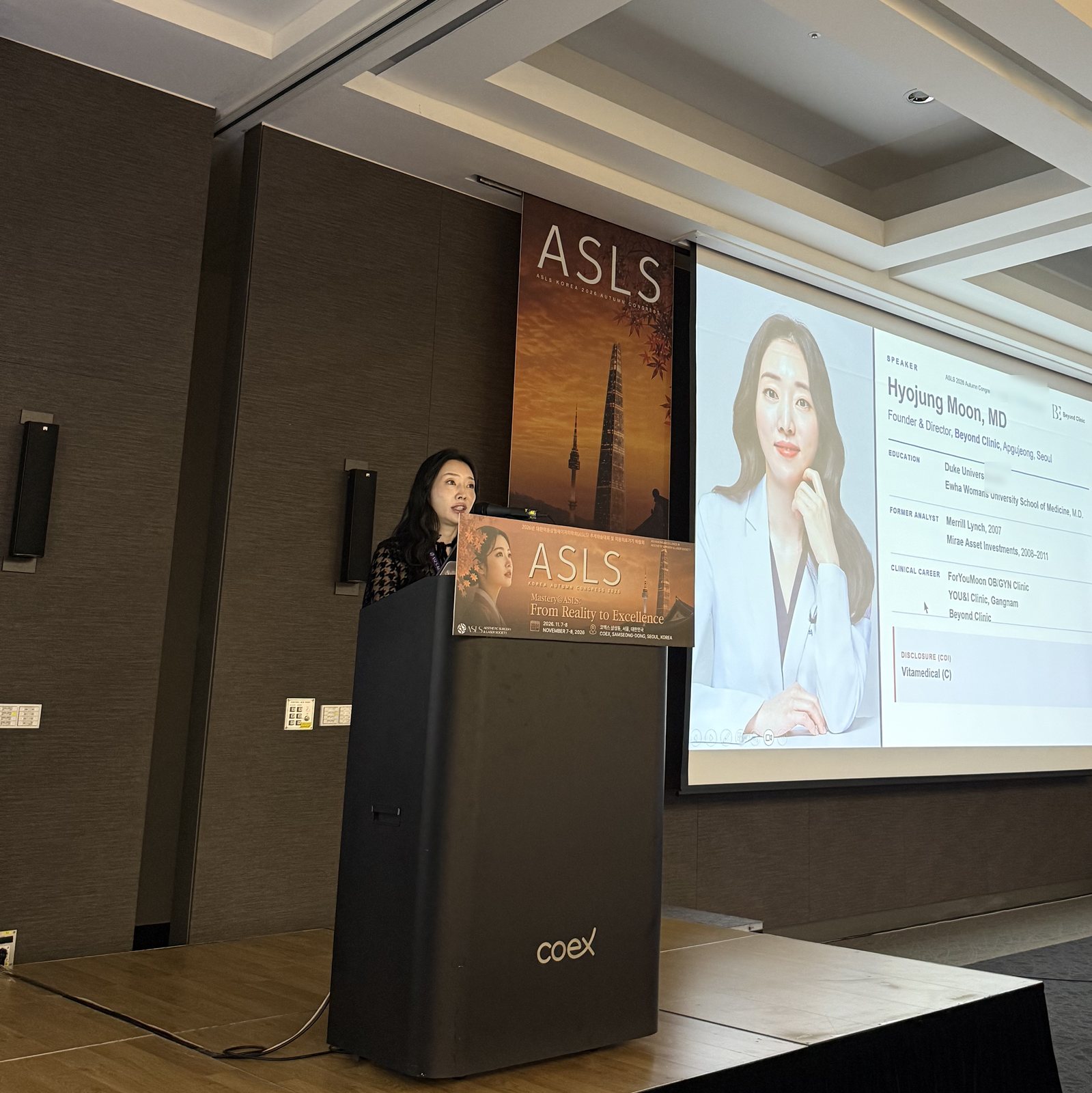
15:11. The stage view includes the podium, speaker introduction slide, and ASLS banner beside the screen.
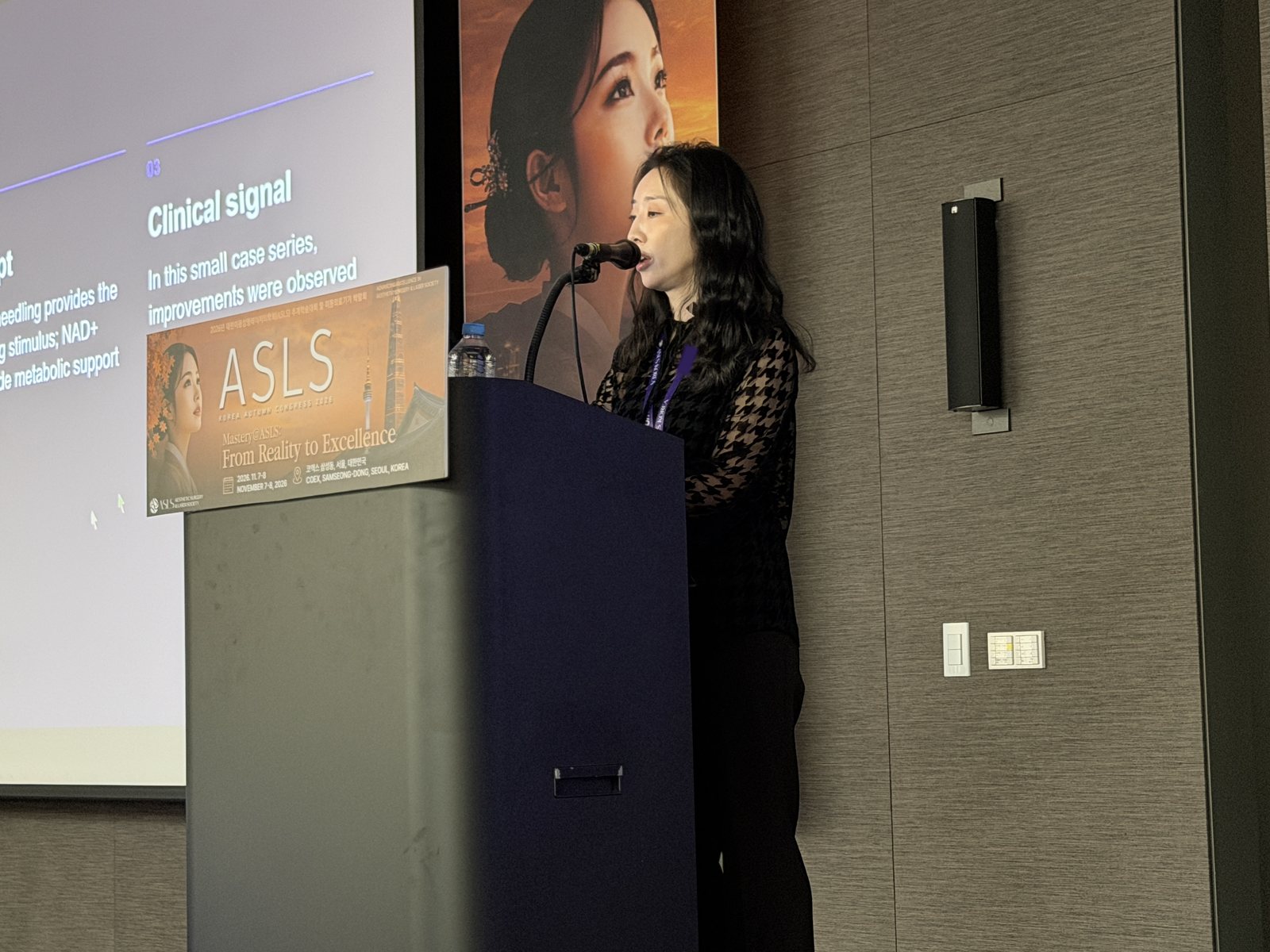
15:22. Part of a closing slide summarizing observations in the small case series is visible behind the speaker.
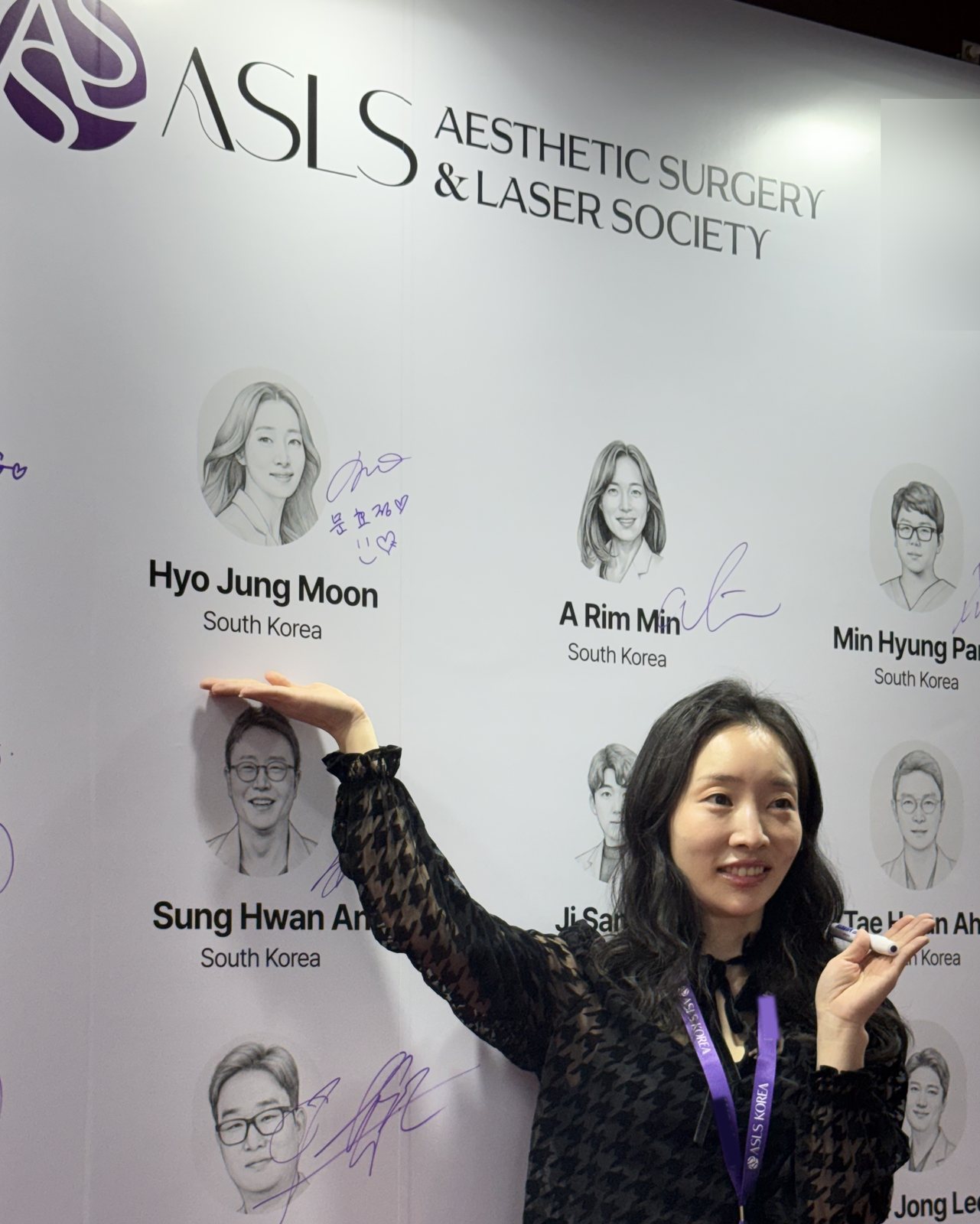
15:46. The speaker points to her portrait and the name Hyo Jung Moon on the speaker wall.
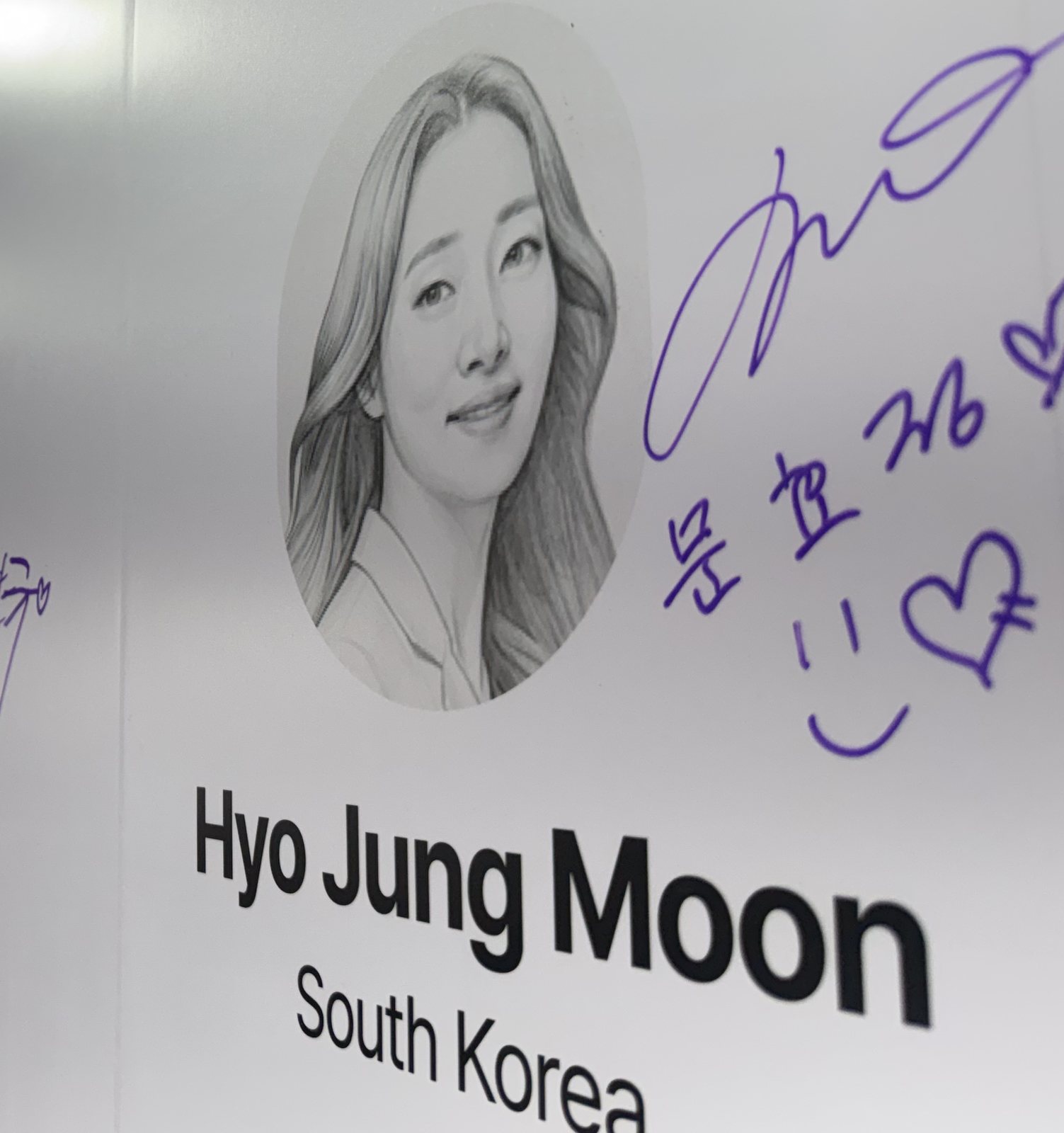
15:48. The wall shows her portrait, the printed text Hyo Jung Moon / South Korea, and her handwritten Korean signature.
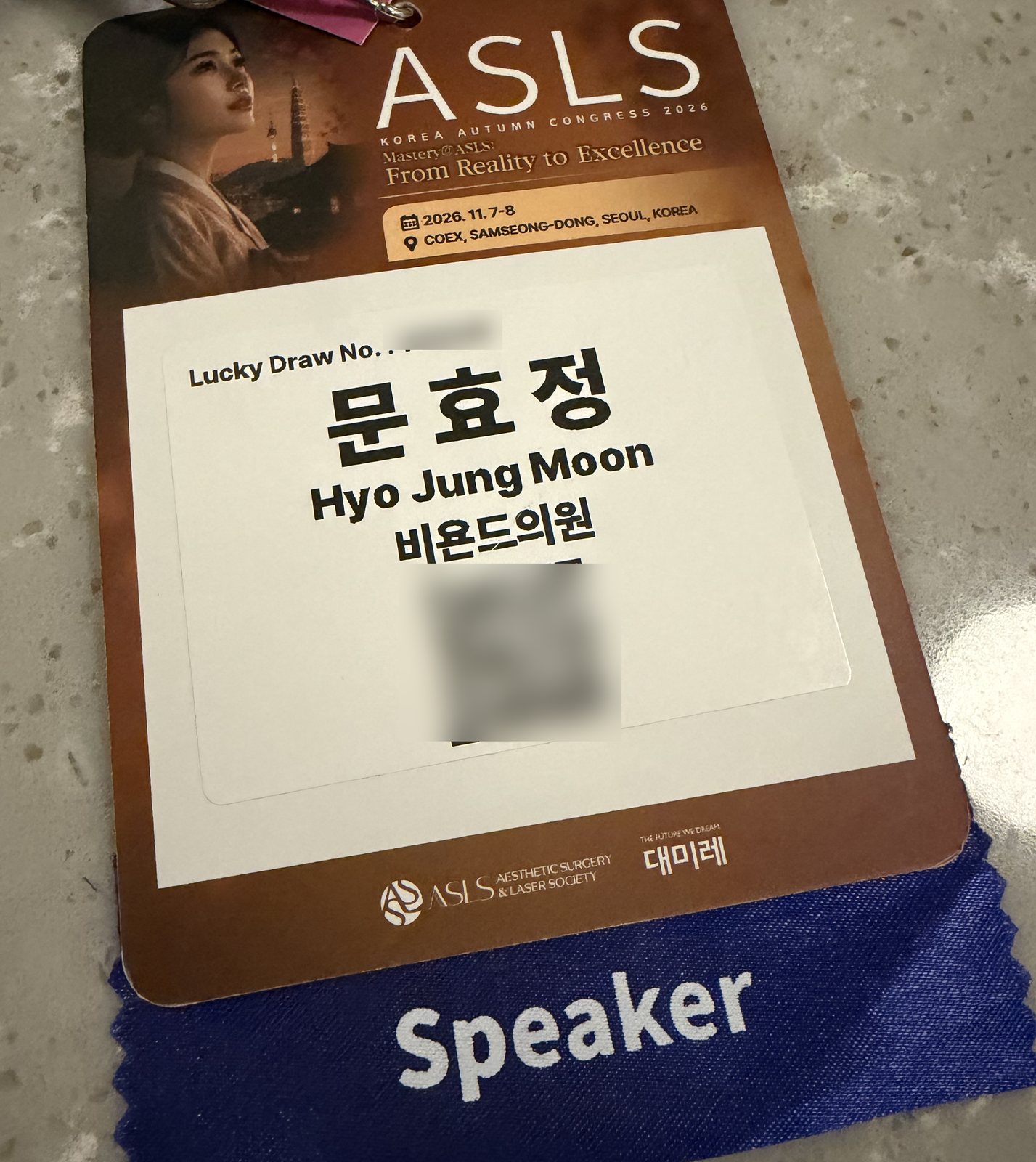
17:18. The badge shows the event name and dates, COEX, the speaker’s Korean name and Hyo Jung Moon, Beyond Clinic, and a blue Speaker ribbon.
Product and device labels on slides and company labels on the lanyard and speaker wall were concealed to limit brand exposure. The badge’s QR code and prize-draw number were also concealed. Photographs of case slides containing patient images are not included here.
The flow of the 19 slides
The 19-slide deck moved from NAD+’s cellular roles to combination observations, related literature, limitations, and the next proposed comparison.[1]
| Slide | Topic | What it covered |
|---|---|---|
| 1 | Title | Pores, post-acne skin, and NAD+ |
| 2 | Speaker introduction | Education, career, and conflict-of-interest disclosure |
| 3 | NAD+ biology | Cellular roles and limits of human evidence |
| 4 | Niacinamide and NAD+ | Different molecules connected by a synthesis pathway |
| 5 | Hypothesis about pore- and acne-affected skin | Animal and cell findings distinguished from what remains unconfirmed in human skin |
| 6 | Combination concept | The assumption of viable-cell delivery and the absence of delivery measurements |
| 7 | Observation methods | Six people received two combined sessions; three cases were shown |
| 8–13 | Three cases | Changes observed in the selected cases |
| 14 | Case summary | Three patterns and skin-tone observations in the other three cases |
| 15 | Related human studies | NAD+ skin application and RF combinations with other ingredients |
| 16 | Interpretation and limits | Uncontrolled observations, photographic limitations, and the next proposed trial |
| 17 | Closing | Biology, the combination concept, and small-series observations |
| 18 | References | Literature used in the talk |
| 19 | Contact channels | Three QR codes for sending questions |
What was actually said
From cellular roles to human evidence
The explanation started with cellular metabolism. Redox reactions transfer electrons.[8]
“NAD+ is best known as a coenzyme in energy metabolism and redox reactions, but it does more than that.”
— Hyojung Moon, MD · Slide 3
From NAD+’s biological importance, the discussion turned to evidence about supplementation in people.
“Scientifically, we still can’t say NAD+ supplementation has an established anti-aging effect in humans, and results vary with the population, tissue, route, and endpoint.”
— Hyojung Moon, MD · Slide 3
Interpretation depends on who receives the substance, which tissue it reaches, how it is given, and which outcome is assessed.
Separating the concerns behind pores and acne
“In patients worried about pores and acne, it’s usually several problems at once. Excess sebum, follicular opening, PIH, pigmentation, redness, and sometimes atrophic scars too.”
— Hyojung Moon, MD · Slide 5
Excess sebum, the appearance of follicular openings, and post-inflammatory hyperpigmentation (PIH), dark marks after inflammation, need to be assessed separately. So do pigmentation, redness, and atrophic scars, depressed areas of skin.
Several concerns may overlap, although the skin condition differs from person to person. See A Map of Skin Surface Concerns: First Questions About Pores, Texture, Acne Marks, and Pigment Changes (in Korean).
Niacinamide, a form of vitamin B3, had appeared as background on slide 4. It is a precursor from which NAD+ is synthesized through intermediate steps, and is a different molecule from NAD+. Human niacinamide findings cannot be transferred to this NAD+ formulation.[1,8]
Direct confirmation in human pore- or acne-affected skin was absent
After discussing aged-skin models and experiments with ultraviolet-damaged skin cells, the speaker specified where that evidence came from.[9,10]
“But actually these are mainly animal and cell studies. To our knowledge, NAD+ depletion hasn’t been directly shown in human acne or enlarged-pore skin.”
— Hyojung Moon, MD · Slide 5
Those experiments alone do not justify calling an individual’s pore- or acne-affected skin NAD+-deficient.
The combination concept depended on reaching cells
“This assumes the formulation reaches viable cells. We haven’t measured intracellular NAD+ level, and delivery varies by device, setting, and compound.”
— Hyojung Moon, MD · Slide 6
The amount reaching cells remains unknown because it was not measured. This does not establish that no delivery occurred.
Related literature led to the need for a direct comparison
The melasma and psoriasis studies of NAD+ skin application appeared on slide 15 alongside RF trials using other ingredients.[11–14] Their skin conditions, formulations, and application methods differ from these observations, so their results cannot be transferred directly. A combination study of another ingredient cannot establish NAD+’s added contribution.
The speaker reported finding no controlled trial adding NAD+ to RF in the literature she reviewed.[1] Study populations and limitations are discussed in article ①.[6]
The closing distinguished biological roles from possibilities
“First, NAD+ links cellular energy, redox control, and stress-repair pathways. Second, radiofrequency microneedling provides the remodeling stimulus, and NAD+ may provide metabolic support for the repair that follows.”
— Hyojung Moon, MD · Slide 17
The first point described NAD+’s biological role; the second raised the possibility of metabolic support during repair. These points did not measure how cells actually responded in the cases.
The third closing point summarized changes observed in redness and inflammation, texture, pores, and skin tone in the small case series.[1]
Limits the speaker stated from the podium
The speaker addressed the limitations directly on slide 16.
“The limits are clear, though. This is an uncontrolled series of patients, and I’ve shown you only three of them.”
— Hyojung Moon, MD · Slide 16
The presentation selected the three cases with clearer changes from six people who received two combined sessions. Without a comparator, it cannot separate the contributions of RF, the whole formulation, NAD+ alone, and time. Those three cases cannot supply the six-person average or a response rate.[1]
Photographs were used for assessment, without quantitative scores. The speaker also discussed follow-up, baseline dates, capture conditions, and missing delivery measurements.
“Follow-up was short, and baseline dates varied. Lighting and skin gloss changed between captures, and we didn’t measure intracellular delivery.”
— Hyojung Moon, MD · Slide 16
Differences in lighting and skin gloss affect how pores, texture, and tone look in photographs. Matched conditions are needed to measure change; short follow-up limits what can be said about persistence.
| What the record establishes | What it cannot establish |
|---|---|
| Speaker, schedule, English delivery, and on-screen title | Society certification of treatment efficacy |
| Three selected cases from six receiving two combined sessions | The full outcome distribution or an individual’s expected result |
| Photographs and physician observation, without quantitative scores | Magnitude of change or NAD+’s isolated contribution |
| Short follow-up, varying baseline dates, and no delivery measurements | Persistence or intracellular NAD+ change |
| A proposed next comparison | Trial implementation, registration, or a confirmed schedule |
Adverse-event data for the combination cases were not presented in the lecture. This cannot be read as a finding of no adverse events or long-term safety. Records need reaction onset, duration, severity, and treatment. See Suspected Adverse Events After a Procedure: What to Know (in Korean).
Additional safety context from separate sources
The following information comes from separate studies and FDA notices. It is included here as editorial safety context, rather than as a record of additional remarks from the podium or adverse events in these six cases.
The separate melasma study in 36 women reported pain, along with redness and swelling that lasted 24–48 hours; PIH was not reported in that small study.[11] The different-ingredient scar trial described transient, self-limited adverse events, with no serious complications reported.[13] Neither provides the missing safety record for these six cases.
Broader RF microneedling safety reports include burns, scars, fat loss, and injuries affecting appearance or nerves. They do not describe these six patients or give an incidence. The FDA advises medical care rather than home use.[15]
An FDA notice on compounded injectable NAD+ reports severe chills, shaking, vomiting, and fatigue, sometimes requiring medical treatment, and warns about microbial and endotoxin contamination from unsuitable ingredients. It does not establish contamination of the formulation discussed in the lecture.[16]
The comparison proposed for the next study
The speaker proposed a split-face comparison: both sides would receive the same RF to test whether adding the NAD+ formulation differs from using a vehicle.
“I’d propose a randomized split-face trial with the same radio frequency on both sides. One side would receive the NAD+ formulation, the other a matched vehicle. We’d use blinded lesion counts and follow patients for at least 12 weeks after the last session.”
— Hyojung Moon, MD · Slide 16
In a split-face trial, the two sides of one person’s face are compared. Both would receive the same RF, and formulation assignment would be randomized. A matched vehicle omits NAD+ while matching the other ingredients and properties.
Blinding keeps the assessor from knowing which formulation each side received. At least 12 weeks after the final session describes the proposed next trial, not follow-up achieved in these cases.
This was a research proposal; implementation, registration, and a fixed schedule have not been confirmed. The lecture did not specify sample size, recruitment population, vehicle composition, application amount or frequency for the trial, or details of safety-data collection.
Questions and contact channels after the lecture
The session organizers invited audience questions after the lecture, but none appears in the record available to the editors. On the final slide, three QR codes offered contact through Instagram, YouTube, or WhatsApp.[1]
About the speaker
Hyojung Moon, MD, is the director of Beyond Clinic. Hyo Jung Moon in the official program, speaker wall, and badge identifies the same speaker. MD denotes a physician.[2,5]
Slide 2 listed an M.D. from Ewha Womans University School of Medicine and graduation from Duke University. The clinic profile lists previous directorships at ForYouMoon OB/GYN Clinic and YOU&I Clinic in Gangnam, followed by the current directorship at Beyond Clinic.[1,5]
The introduction slide also listed analyst experience at Merrill Lynch in 2007 and Mirae Asset Investments in 2008–2011.[1] Education and clinical background are available in the Profile of Hyojung Moon, MD.[5]
How a conference presentation differs from certification of efficacy
A conference presentation records who reported what and where. Whether sufficient evidence supports the combination’s effects requires a separate assessment; holding the lecture does not amount to society certification of treatment efficacy.
A presentation communicates material and interpretation in spoken form. An abstract is a brief summary, while a peer-reviewed paper reports methods and results after external journal review.
These uncontrolled observations can help define a question for the next comparison. Efficacy assessment requires an appropriate comparator, outcome measurements, and follow-up. Even readers with similar concerns cannot use selected case changes to predict their own results.
Conflict-of-interest disclosure
Slide 2 showed Vitamedical (C) as the conflict-of-interest disclosure.[1] The meaning of C, contractual or payment details, and whether formulations or research funding were supplied have not been confirmed.
The observations came from the speaker’s own practice, and the speaker is also this article’s medical reviewer. This is not an independent external reassessment. Disclosure does not remove the need for comparators and measurements, and the relationship alone does not invalidate the observations.
Before a clinical visit, see What to Prepare Before a Procedure Consultation (in Korean).
This record explains the remarks and observational limits of the ASLS 2026 English lecture. Ingredient and procedure names identify its subject matter rather than recommend a product or procedure. Seek medical assessment if redness persists after a skin procedure or pain and swelling worsen.
References
- Moon H. Remodeling Pores and Post-Acne Skin with an NAD+ Bioactive Platform. ASLS KOREA 2026 AUTUMN CONGRESS; November 8, 2026; COEX, Seoul, D Room. Conference presentation in English, 19 slides. Public release of the complete deck has not been decided.
- ASLS KOREA. ASLS 2026 official program. Program.
- ASLS KOREA. “ASLS란?” (in Korean). Event overview.
- COEX. “대한미용성형레이저의학회 미용의료기기 박람회 및 추계 학술대회 2026” (in Korean). Event listing.
- Beyond Clinic. “문효정 원장 소개” (in Korean). Physician profile.
- Beyond Clinic. ① Experimental Studies Link NAD+ to Skin Repair, but Human Skin Research Is Still Preliminary.
- Beyond Clinic. ② Changes in Red Lesions and Pore Visibility Were Reported After RF Microneedling with NAD+.
- Covarrubias AJ, Perrone R, Grozio A, Verdin E. NAD+ metabolism and its roles in cellular processes during ageing. Nat Rev Mol Cell Biol. 2021;22(2):119-141. PubMed.
- Wong W, Crane ED, Zhang H, Li J, Day TA, Green AE, et al. Pgc-1α controls epidermal stem cell fate and skin repair by sustaining NAD+ homeostasis during aging. Mol Metab. 2022;65:101575. PubMed.
- Katayoshi T, Nakajo T, Tsuji-Naito K. Restoring NAD+ by NAMPT is essential for the SIRT1/p53-mediated survival of UVA- and UVB-irradiated epidermal keratinocytes. J Photochem Photobiol B. 2021;221:112238. PubMed. Abstract-level evidence.
- Yi KH, Wan J, Hwang S. Efficacy and Safety of a Topical Nicotinamide Adenine Dinucleotide Skinbooster for the Treatment of Melasma. Aesthetic Plast Surg. 2026;50(11):4431-4436. PubMed.
- Wozniacka A, Szajerski P, Adamus J, Gebicki J, Sysa-Jedrzejowska A. In search for new antipsoriatic agents: NAD topical composition. Skin Pharmacol Physiol. 2007;20(1):37-42. PubMed.
- Kupwiwat R, Techapichetvanich T, Bhorntarakcharoen W, Sittiwanaruk S, Li JB, Manuskiatti W. Transdermal Delivery of Poly-L-Lactic Acid via Fractional Microneedle Radiofrequency for Atrophic Acne Scars: A Split-Face Randomized Study in Fitzpatrick Skin Types III to V. Dermatol Ther (Heidelb). 2026;16(2):1089-1097. PubMed.
- Gulfan MCB, Wanitphakdeedecha R, Wongdama S, Jantanapornchai N, Yan C, Rakchart S. Efficacy and Safety of Using Noninsulated Microneedle Radiofrequency Alone Versus in Combination with Polynucleotides for the Treatment of Melasma: A Pilot Study. Dermatol Ther (Heidelb). 2022;12(6):1325-1336. PubMed.
- U.S. Food and Drug Administration. Potential Risks with Certain Uses of Radiofrequency (RF) Microneedling – FDA Safety Communication. October 15, 2025. FDA.
- U.S. Food and Drug Administration. FDA reminds compounders to use ingredients suitable for sterile compounding. FDA.
Frequently asked questions
What did Hyojung Moon, MD, present at ASLS 2026?
Hyojung Moon, MD, presented observations of an NAD+ formulation combined with radiofrequency microneedling, focusing on visible pores and post-acne skin changes. Three cases were selected from six people receiving two combined sessions. Without a comparator, NAD+'s contribution cannot be isolated. See Changes in Red Lesions and Pore Visibility Were Reported After RF Microneedling with NAD+. During a consultation, clarify how the skin concerns discussed differ from your symptoms.
When and where was the ASLS 2026 autumn congress held?
The congress took place on November 7–8, 2026, at COEX in Samseong-dong, Seoul. The event listing establishes the overall dates and venue; the program identifies individual lectures. Hyojung Moon, MD's 15-minute lecture was scheduled for November 8 in D Room, 15:10–15:25. See Changes in Red Lesions and Pore Visibility Were Reported After RF Microneedling with NAD+. Tell the clinician which skin concern led you to read about the presentation.
Was the NAD+ talk delivered in English?
Yes, Hyojung Moon, MD, delivered the talk in English with 19 English-language slides. Presentation language does not change the observations' evidence level. See Changes in Red Lesions and Pore Visibility Were Reported After RF Microneedling with NAD+ for an account of the presentation. Ask a clinician about unfamiliar terms and which findings apply to your condition.
Do Hyo Jung Moon and Hyojung Moon refer to the same speaker?
Yes, Hyo Jung Moon and Hyojung Moon identify the same physician in these records. The official program and badge use Hyo Jung Moon, while the slides and clinic profile use Hyojung Moon. A shared name does not justify attaching another person's history. Education and clinical background are listed in the Profile of Hyojung Moon, MD. Mention which presentation or profile prompted your question during a consultation.
What questions and answers were recorded at the venue?
The session organizers invited questions, but the record available to the editors contains no audience question. The final slide displayed three QR codes for Instagram, YouTube, and WhatsApp. An individual's skin question requires assessment separate from these observations. See Changes in Red Lesions and Pore Visibility Were Reported After RF Microneedling with NAD+. Bring the symptom onset and previous treatment history to a clinical consultation.
Does a conference presentation certify treatment efficacy?
No, presenting at a congress does not certify this combination's treatment efficacy. The comparator, outcome, measurements, and follow-up determine what can be inferred. These observations cannot establish NAD+'s contribution or long-term safety. See Experimental Studies Link NAD+ to Skin Repair, but Human Skin Research Is Still Preliminary. Ask which evidence and alternatives address your own skin concern.
What conflict of interest did the speaker disclose?
The speaker disclosed a Vitamedical-related conflict of interest on slide 2, shown as Vitamedical (C). The observations came from the speaker's own practice, and the speaker is also this article's medical reviewer. The meaning of C and contractual or payment details have not been confirmed. The disclosure also appears in Changes in Red Lesions and Pore Visibility Were Reported After RF Microneedling with NAD+. Distinguish what was observed in the presentation from an individual clinical decision.
Where can I read the talk findings and the NAD+ literature evidence?
The other two articles cover these separately: article ② describes the methods and cases, while article ① explains study populations and limitations. Public release of the complete slides has not been decided. See Experimental Studies Link NAD+ to Skin Repair, but Human Skin Research Is Still Preliminary and Changes in Red Lesions and Pore Visibility Were Reported After RF Microneedling with NAD+. Before a consultation, organize your symptoms, earlier procedures, and medicines for the clinician.